
Shop Now
From Our Blog
-
Weldclass backs Ashton Cattach at the 2026 Bathurst 1000
Weldclass backs Melbourne welder and racer Ashton Cattach in the GR Cup at the 2026 Bathurst 1000. Session times and how to watch on Fox Sports and Kayo. -
FURY MPST Series: How-To Videos
Video guides for Weldclass FURY MPST Series MIG/TIG/Stick Pulse welding machines.

Welders, Single-Phase Power, and Plugs: Your questions answered
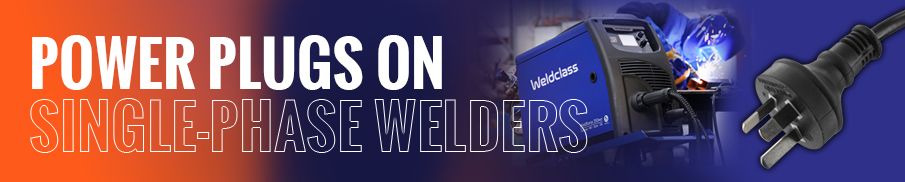
We often receive questions from users of single-phase welding machines & plasma cutters, such as:
Can I use a 10A plug on my welder?
Why does my circuit breaker keep tripping?
Why is my machine cutting out?
What size plug or power supply should I use?
This article is intended to respond to some of these FAQs in simple laymans terms.
Please note that this is a complex topic to explain in full detail, and for more complete, technically detailed information we would refer readers to the applicable Australian standards mentioned below.
Tips For Using Welders on 10A Single-Phase Power
On the one hand welders are relatively power-hungry (compared to other common power tools). On the other hand, 10 Amp power can only supply a limited amount of current. This 'conflict' can result in issues such as tripping of circuit breakers, and/or welding machines cutting out due to duty-cycle limitations.
Here's some points you should be aware of:
- While the Australian standard for single-phase power is 230V, the output at any wall socket can vary from one location to another, or even vary at different times of the day. Variations from 200V-250V or even wider are not uncommon.
- These variations in supply voltage (V) will change current draw (A) of the welding machine, which will also change the duty cycle. If voltage supply decreases, the machine will draw more power. If voltage supply increases, the machine will draw less power.
- The current draw of a welding machine is not just related to the output setting (amps). Just some of the many factors that will vary current draw include: power supply (as mentioned above), ambient temperature, operator technique, types of shielding gas (which influence weld temperature), type/size of wire/electrodes used, etc.
If your welder is frequently tripping circuit breakers and/or cutting out (exceeding duty cycle), here are some suggestions:
- Reduce the amperage (A) output setting on your machine. The higher the amperage, the more power the machine will draw.
- Consider installing Type-D circuit breakers (often called slow-blow breakers). A D-curve breaker is designed to tolerate 10–20 times its rated current for a short period before tripping. D-Curve breakers are recommended to prevent nuisance tripping, particularly for 180A+ welding machines.
Power plug size vs welding machine size
The Australian standard "AS60974.1 Arc welding equipment Welding power sources" stipulates that the plug (and power input cable) should be rated to the "effective input current" rating of the machine.
The "effective input current" is typically shown on the machine data plate, with the symbol I1eff.
If a machine has I1eff rating of 10A or less, it can be fitted with a 10A plug.
If a machine has I1eff rating of more than 10A & up to 15A, then it should be fitted with a 15A plug.
And so on.
The higher the output capacity of the machine (amps), the higher the I1eff effective input current rating will be. Other factors that will impact the I1eff rating from one model/brand of machine to another, include efficiency, power-factor, functions/processes, duty-cycle, etc.
More about 'effective input current rating' (I1eff)
In very simple terms, I1eff is something like an average or median current draw. (The mathematical formula to calculate I1eff is complex, and will depend on the duty-cycle, efficiency, power-factor, max output, and other parameters).
I1eff should not be confused with the maximum/peak current draw (I1max) of the machine, which will always be higher. For example a machine might have I1eff rating of 15A, but I1max rating of 32A.
Also note that I1eff rating takes into account the full, or maximum, output range of the machine. If a machine is being used at lower-than-maximum output and/or duty cycle, then the 'actual' current draw of the machine at that point in time will be lower than the I1eff rating shown on the machine's data plate.
What happens if I fit/use my welder with a smaller plug?
Users often ask about fitting a different (smaller) size plug to their welding machine, to allow use on a more readily-available or convenient power supply. For example, fitting a 10A plug to a machine that was supplied and designed to be used with 15A plug. A few points on this;
Actual 'real time' current draw is relative to the output
If a 15A rated machine, for example, is only used on relatively low output and/or duty-cycle, the 'actual' effective current draw at that point in time may be 10A or less. If so, then some users may argue that a 10A plug can be used in this application.
Let's say we have a Weldclass 205MST 200A welder which has I1eff rating of 15A based on full output, however we are only using it at say 140A output @ 15% duty-cycle. In this case the 'actual' current draw will be less than 10A.
Some larger machines on the market (eg 250A & above) are supplied with two different output ratings/levels on the data plate, to indicate the maximum output that the machine should be used at in order to be used with different plug/circuit sizes. For example, a 250A machine with a I1eff rating of around 20-30A at full output, but with additional ratings/date to show max output to achieve I1eff 15A to allow use with 15A plug.
Some Weldclass machines also have the convenience of special programs that change the machine output to allow use with different power outlets, for example the 210MST MIG & 202T TIG have 10A/15A programs, and the 290MST MIG has 15A/32A programs.
Consequences
As explained above, if the machine is not being used at high output and/or duty-cycle*, this reduces the current draw and will avoid overdrawing the power supply beyond it's rated capacity... and in this case everything can be expected to operate normally.
*So that the actual I1eff effective current draw is not higher than the power curcuit being used
However if using the machine on high current/amps, and/or high duty-cycle (welding frequently and/or for longer periods at a time), this increases the current draw. If / when the machine 'actual' current draw exceeds the rating of the power supply circuit/outlet, this will likely trip the circuit breaker.
You should also be aware that if a power curcuit is overdrawn (especially excessively or repeatedly), there is also risk of overheating the power supply circuit componentry and causing fire hazard. This is why you should be aware of and comply with the AS60974.1 I1eff rating requirements as mentioned in this article.
Is there a risk of damage?
Using a 15A-rated machine on 10A power supply is unlikely to cause damage to the welding machine itself, as the machine will be effectively operating at less than full capacity. However, as mentioned above, if the current draw exceeds the rating of the 10A power supply circuit/outlet, there is a risk of overheating the power supply componentry and causing fire hazard, such as wiring or socket/plug burn-out. Insurance may be voided for incidents where incorrect power supply is deemed to have been used.
Will I damage a 10A plug if I connect it to higher-spec 15A outlet?
No. The only major difference between a 10A and 15A plug is the size of the earth pin. The earth pin is a safety feature and does not normally carry any current/power. The purpose of a larger pin on 15A plug is simply to prevent it being connected to a 10A power outlet.
If using generator power, please refer to these guidelines.
While all care has been taken to ensure the information presented is accurate, Weldclass accepts no responsibility for any errors or omissions in this article. The information given is of a general nature only and does not take into account the specific circumstances of any individual application or situation, and should not be used as a substitute for professional advice (such as from a qualified electrician or electrical engineer). All applicable safety standards (including Australian standards), industry guidelines and regulations should be consulted and followed. This article is intended to assist readers who do not have technical expertise or training (such as electrical engineering qualifications) with a basic understanding of the topics presented, and as such some terminology may be imprecise, and the information given will not be a complete or exhaustive resource. Weldclass does not condone or recommend using any machine in a manner that is contrary to Australian standards requirements or manufacturer's instructions. E.&O.E.